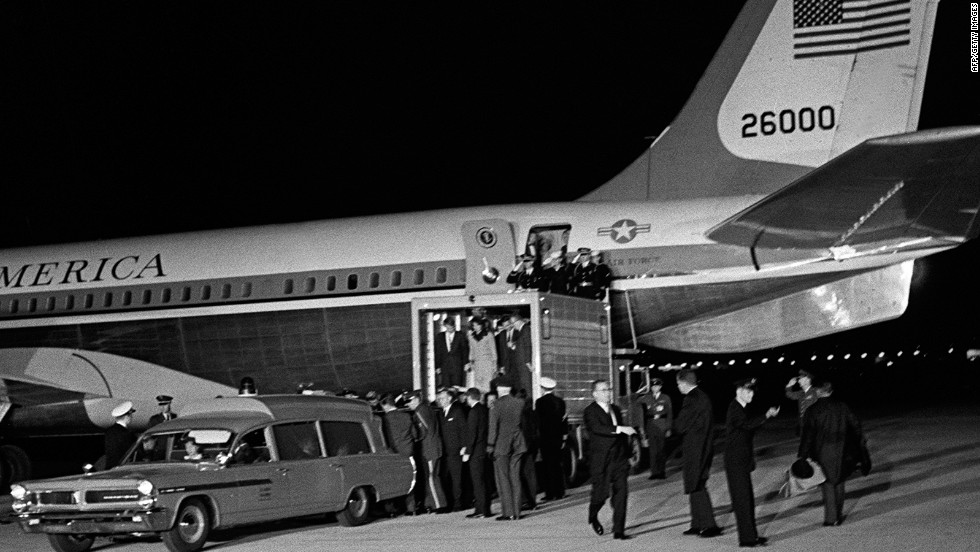
Fifty-seven years ago today at exactly 12:30 pm Central time, JFK was assassinated in Dallas, Texas. The medical staff at Parkland Hospital declared him dead a half hour later. I remember watching the arrival of the president’s casket and Mrs. Kennedy at Andrews Air Force Base in Maryland that evening. As a young boy, I didn’t know what a president or an assassination was–my father had to explain both–but I could see clearly that something momentous was happening. The assassination had stopped the adult world in its tracks, which fascinated me.
Something else fascinated me, especially after watching replays of the murder of Lee Harvey Oswald by Jack Ruby two days later on Sunday morning, November 24, 1963. Not knowing the details of the events that occurred that weekend and being incapable of putting them into their proper context even if I had known, I viewed the three murders (i.e., the president, Dallas Police Officer J.D. Tippit, and Oswald) and the drama that engulfed them through the only lens available to me. That is, ritual sacrifice.


My parents had saved up enough money to enroll me in a Catholic grammar school, and at the time I was preparing for Confirmation and Eucharist. Sacrifice, death, and betrayal formed a significant part of the catechesis, which included ritual acts, prayer, fasting, and good deeds (see Lent Lingers On).
This served as an ideal lens for me to interpret the events in Dallas and the subsequent funeral and burial at Arlington National Cemetery (see New World Disorder). Kennedy, being Catholic, ensured that the experience would remain with me forever and that death would affect the way I approached life, which is to say through a continuum of dying-death-resurrection. My school put a coffin draped in black in the nave of the church in front of the communion rail. The nuns ushered us in every day to pray for the soul of the dead president and the nation. For a young boy, it made death tangible.
I witnessed another change in the adult world, one that perplexed me. I wasn’t certain how the assassination related to adults, but I noticed that eventually they went back to doing the same things in the same ways as if nothing had happened. I not only found this objectionable but considered it a betrayal of a leader who was sacrificed in much the same way that Jesus was sacrificed. In my mind, being gunned down in Dealey Plaza was no less bloody than being tortured and crucified on Calvary.

Which brings me back to the night of November 22, 1963 at Andrews Air Force Base. If you ask most people who were around at the time what they remember from that night, they’ll tell you about the truck backing up, the lowering of the casket into the ambulance, and Bobby and Jackie Kennedy coming down from the truck to escort the body of the president. They may even recall the blood spatter on Jackie’s dress.
But what many people overlook is the new president’s address to the nation, his first in that role. Lyndon Johnson stood on the tarmac that night with his wife, “Lady Bird,” at his side as the world waited for news, comfort, and, most importantly, a sign that the new head of state was firmly in command of the situation.
It was an unenviable task given that many people were still in shock and the focus remained on President Kennedy, Jackie, and the investigation back in Dallas. You couldn’t help but feel sorry for this gangly man as he strode to the microphones with his simple wife, both of whom looked quite ordinary next to the Kennedys. Still, Johnson stared through his thick glasses and began.
“This is a sad time for all people,” he drawled. “We have suffered a loss that cannot be weighed. For me, it is a deep personal tragedy. I know that the world shares the sorrow that Mrs. Kennedy and her family bear. I will do my best. That is all I can do. I ask for your help—and God’s.”
The best thing about the speech is that Johnson kept it short and simple. He was humble. No Gettysburg Address here, but then that would have been inappropriate. Still, something was missing. The energy and optimism were gone. The flair had fizzled. Although I couldn’t explain it, I felt it. I felt loss, disappointment, a kind of death. Or was it betrayal? Whatever it was, I knew that we were back to business as usual. Come Monday morning, I would have to go to school again.
Image credits: feature taken from “November 22, 1963: A Photo Essay,” The Atlantic. Andrews Air Force Base from CNN. Want more? Go to Robert Brancatelli. The Brancatelli Blog is a member of The Free Media Alliance, which promotes “alternatives to software, culture, and hardware monopolies.”